Life does get in the way
Exercise and poor mental health are at war with each other: exercise can be an effective treatment for a condition that, by its very nature, dampens your will to move.
Most exercise programs don’t consider psychological hurdles. Motivation is the nucleus of self-improvement. It is the ocean between should and can. Mass market programs are made to be sold; asking “Is this even possible for you?” is a poor retail tactic.
The most important point when motivation is at play is just emphasizing that any exercise is better than none.
A systematic review and meta-analysis of 15 prospective studies of nearly 200,000 people noticed “significant mental health benefits from being physically active, even at levels below the public health recommendations.”
Quality, not quantity. Never mind 150 minutes—let’s start with five.
There’s such a thing as too much
In fact, too much physical activity too quickly can manifest as a form of self-harm, masking important emotions.
Listen to your body
A structured exercise program can be a catalyst. However, trusting yourself and being in touch with your emotions is paramount. Whatever gets you out the door: do you like to walk, play tennis, hike?
Antidepressants have the common side effect of weight gain, which can lead to body dysmorphia. While both sexes can feel pressure to conform to a societal norm, men suffer differently.
Some men are trying to achieve an unrealistic goal, which leaves them in a state of dissatisfaction. While chasing it, they’re still doing things that seem outwardly healthy, like going to the gym. They’re eating food in what seems to be a healthy manner, but perhaps that has led them to use performance-enhancing drugs. It circles back to just being someone who is trying to deal with those demons themselves and not seeking support.
It’s a beautiful thing to move in your body, be in your body, and just listen.
Sources of hydration for exercise
| water | carbonated water is just as effective |
| sports drinks | make your own by adding 1/2 tsp (2 mL) of salt per litre of water, along with some sweetener or fruit. |
| coconut water | contains high levels of potassium |
| chocolate milk | contains the necessary fat and protein |
| green tea | improves the function of the body during exercise |
How to get started
- Start simple.
- Do what you enjoy.
- Set reasonable goals.
- Try not to think of exercise as a chore.
- Plan for, and accept, setbacks.
Strength training simplified
The six key movement patterns
Fundamental movements versus isolated muscle groups
Instead of spending the bulk of your training time working individual muscle groups, prioritize the six movement patterns in your workouts. Each involves multiple joints and muscle groups and thus allows you to lift more weight. They’re more effective for gaining functional strength, increasing your metabolic rate, and improving bone density.
The six fundamental movement patterns
Squat
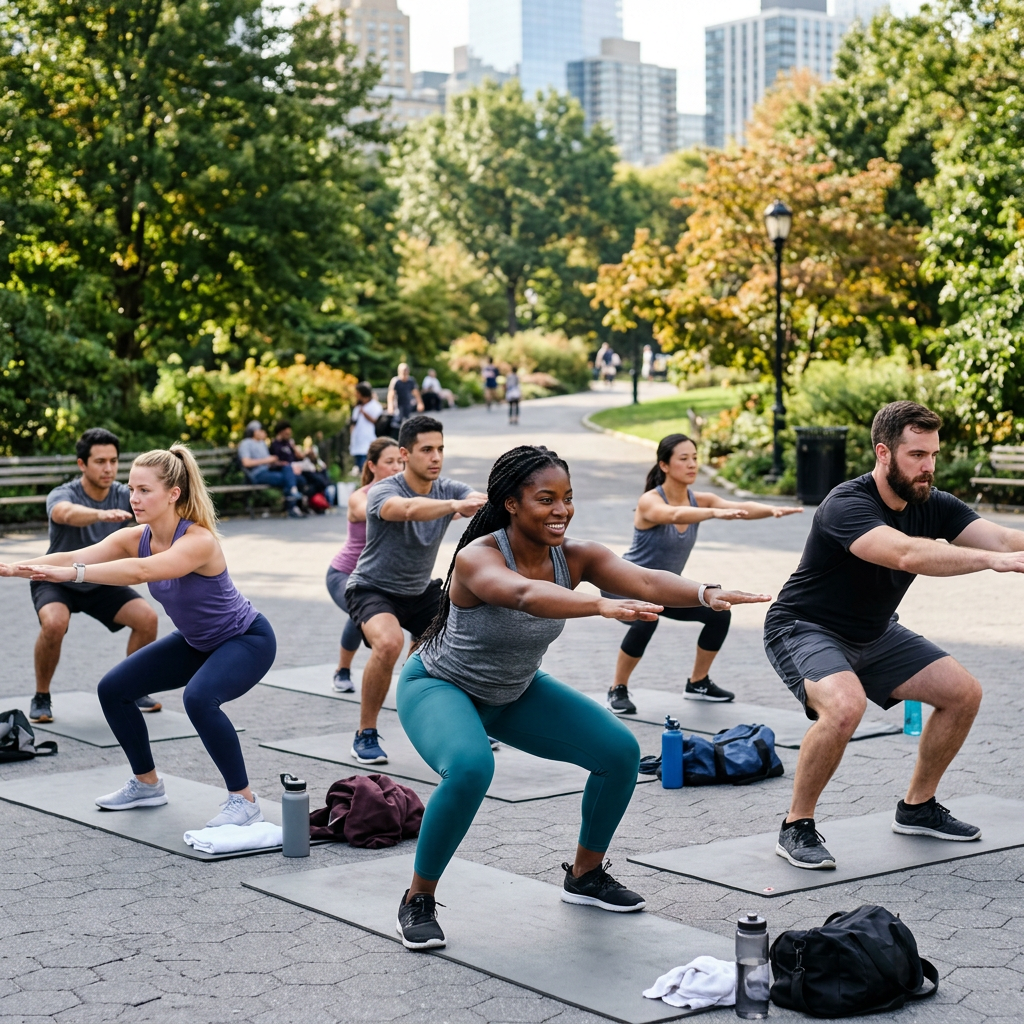
Squatting involves lowering your body by bending your hips and knees, then returning to a standing position. It’s required for activities like sitting or getting up from a chair, or getting in and out of a car.
Variations: goblet squat, barbell back squat, sumo squat, resistance band squat, dumbbell front squat
Hinge
Also known as a deadlift, hinging involves bending at the hips with minimal knee movement. This engages the posterior chain muscles, including the glutes and hamstrings. This movement is essential for lifting heavy objects from the floor without straining your low back.
Variations: barbell deadlift, kettlebell deadlift, single-leg deadlift, kettlebell swing
Lunge
In a lunge, one leg steps forward or backward, lowering your hips toward the ground. This pattern improves balance and unilateral strength, crucial for actions like climbing stairs or getting up from the floor.
Variations: lateral lunge, forward lunge, reverse lunge, walking lunge
Push
Pushing movements involve pressing weight away from the body, engaging the chest, shoulders, and triceps. Daily examples include pushing a door open or placing items on a high shelf.
Variations: push-ups, barbell overhead press, barbell bench press, dumbbell incline press, kettlebell single-arm overhead press
Pull
Pulling actions draw weight toward the body. Working the back and biceps, you use this pattern closing a garage door, pulling down windows or blinds, or dragging a chair across the floor.
Variations: seated row, pull-ups, lat pulldown machine, dumbbell bent-over rows, resistance band rows
Carry
Carries require holding weight while walking, strengthening the core, upper body, and grip. You perform this movement pattern when you’re hauling groceries from the car into the house. Gradually work your way up to carrying the equivalent of your body weight—half in each hand—for 20 to 30 seconds. (This is logistically much easier with dumbbells or kettlebells, rather than groceries!)
Variations: kettlebell carry, overhead carry, yoke carry, sandbag carry
You don’t need to include all six movement patterns in every workout. Just make sure you’re training each pattern at least once a week.
When my coaching team and I design workouts for our clients, we prioritize the foundational movement patterns before incorporating any single-joint or isolation exercises. Clients training twice a week typically don’t perform isolation movements at all. For those training four times a week, we may add one or two isolation exercises at the end of a session, but the focus remains on compound, foundational movements.
You’re now ready to squat, hinge, lunge, push, pull, and carry your way to more effective workouts!
By Karina Inkster
BetsyHealth Note: This article is for educational purposes only. It is not intended to diagnose, treat, prevent or cure any disease. Consult your healthcare provider before trying a supplement or beginning an exercise program, especially if you have a medical condition, including being pregnant or nursing, take prescription or over-the-counter medications, or are planning on having surgery.
Article copyright 2026 by Alive Publishing Group, Inc. All rights reserved. Used with permission.


You must be logged in to post a comment.